• Joseph

    When you cross the border from Laos to Thailand it’s like traveling forward in time 50 years.  Suddenly there are real highways with lights, multi storey buildings, recognizable store names, franchise restaurants and lit up billboards.  Some would say it’s not for the best.  For me, I’ve just been surprised at the level of development in this country.  It is more similar in the appearance of it’s towns and infrastructure to China than to any place we’ve been in South East Asia. 

  • Joseph

    For most travelers, Vientiane – the capital of Laos, is a one night stop on the way between north and south Laos.  We’ve happily spent the last four nights here doing two things; eating and re-planning our trip. 

    Laos is a former French colony so we decided to splurge and go out to a nice French restaurant on our first night here.  While traveling through Cambodia and southern Laos we’d eaten rice based dishes for breakfast, lunch and dinner.  And although they were often delicious, I was ready for a change; specifically, I craved a nice steak. 

    We found our way to Le Silapa, a nice place with plaster walls and exposed wood beams.  Penny ordered the duck and I had steak frites with tarragon butter.  For dessert we had a silky smooth chocolate creme brulee and a couple of Bailey’s on ice. 

    After dinner we sat and talked with the owner Frederic, over a couple of drinks.  It turns out he is not a leftover from the colonialist days but moved here 12 years ago from Quebec City.  We truthfully told him that the food was as good as anything we’ve had back home.  And it was made
    all the more impressive by the logistical difficulties of getting all
    the ingredients to Laos.  As he put it; in a country where you often can’t buy cream it is a real challenge to run a French restaurant.  Our bill for dinner was less than half what one would pay in Canada for a similar meal.  However, it still came out to over six times as much as our hotel for the night!

    Other than enjoying the variety and selection of food, the rest of our time in Vientiane has been spent recreating our trip itinerary.  Some keen followers of our trip have noted that we are already about a month behind schedule despite being only 3 months into the trip.  This fact caused us to reevaluate our itinerary and cut out some destinations in order to spend more time in others.

    We’ve spent much of the last few days in Internet cafes researching, planning flights and making bookings.  We will post our updated itinerary sometime in the next few days.  It feels good to have a better (more realistic) plan.  As part of our new itinerary we’ve decided to leave Laos today and unfortunately skip the northern part of the country.  We will be taking an overnight bus to Chiang Mai in northern Thailand and will post again when we’re there.

  • Penny

    We have posted a new album called "Southern Laos".  Enjoy!

    Laos is home to many ethnic minorities whose beliefs and language are very different from that of the Lao population.  The country’s 3 major minorities are the Highland, the Midland and the Lowland minorities.

    Our 3 day trek in the Dong Phu Vieng National Protected Area (NPA) brought us in close contact with a Lao Midland minority called Katang.  We completed the trek with another couple from Holland (Oscar and Raquel) and were accompanied by 2 semi-English speaking guides and 2 local guides for the jungle treks. 

    Curious_katang_childrenThe trip consisted of trekking during the day and getting to a local Katang village by 4 PM each day.  There we would meet our host family and the village leaders and would try our best to communicate with them as the guides prepared our meal. 

    The highlight of the trek was the time that we spent in the villages; walking around while our entourage  of local children followed us everywhere, speaking to the villagers, and bathing at the local water pump or river while being closely watched by the locals.  With no electricity and limited entertainment options, we (the ‘falang’ meaning foreigners in Lao) were the main source of entertainment.

    Village life is very basic.  Families grow rice, vegetables and raise cows, goats, pigs, buffalo, chickens and ducks.  Most of what they grow and raise is for their own consumption.  They rarely sell anything at local markets.  Most of the daily chores are done by the women of the village.  One of the tasks that is strictly reserved for women is the husking of the rice that is done by 2 women alternately pounding the rice with a very large wooden mortar and pestle.  On both morning we were abruptly woken by their rhythmic sounds at 2:30am and 3:30am respectively. Katang_minority_village_2

    When we arrived at each village, we were only greeted by the men while the women hid out of sight.  All the drinking, eating and singing was only to be enjoyed by the men.  Thankfully the ‘no women’ rule did not apply to tourists and Raquel and I were allowed to participate and to sleep-in.

    The villagers believe in spirits and they take care to keep them happy.  They believe that each house has a "house spirit" and it is consulted for everything from whether you are allowed to clap in the house or whether you are allowed to take rice out of the "rice storage house".  We made sure to be on our best behaviour because if we did anything to offend a spirit, an animal sacrifice would be made to appease them.  One of the big no-nos in their culture is having female and male guests sleep together.  So, Raquel and I slept on one side of the room while Oscar, Joe and the guides slept on the other with our feet pointing to the inside of the house (as having your feet point to an outside wall or to someones head are 2 other no-nos).

    The men in the village had a lot of questions for us.  Most were very basic like where we were from and ifVillage_elder_at_welcoming_ceremony  we were married while others were a little more surprising.  One old man asked: "Where does the world end?"  We all looked at each other taken aback.  He then added "Where do you fall off the earth?" and using a pack of cigarettes to show the flat earth, he demonstrated with his fingers how you would fall when you reached the end of the pack.  We explained that there is no end-point and that the earth was round using our clenched fists to represent a round shape of the earth.  We tried to explain to him that we were doing a trip around the world that started in Canada and went all the way around the earth.  I do not think that he believed our explanation and probably started asking the spirits to save us from a horrible death by falling off the earth.

    Even though some still believe that the earth is flat, all villagers had heard of Canada.  The road into the village, the village school and the 2 water pumps were all built by the Canadian International Development Agency (CIDA).  We received hundreds of thank you’s from the villagers for our country’s contributions and we were asked to thank the people of Canada for improving their lives.  So, here it goes "Thank you Canada on behalf of the Katang Village in Laos"!

  • Penny

    Travel in Asia is always eventful.  There is always something new and bizarre for Joe and I to see and to make us appreciate the transportation system (including all its rules) that we have in Canada.

    Today, we made a 230 km journey from Pakse to Savanakhet in Laos.  The relatively short journey took a total of 5 hours and 50 minutes to complete. The bus stopped at every opportunity to add on more passengers.  Even when the seats were filled, the driver pulled out a stack of plastic stools that were placed in the middle of the walkway for people to sit on.  Thankfully, Joe and I had already claimed two seats by the time the bus was full.

    It felt like every nook and cranny was used to transport something.  From live chickens in the cargo hold underneath the bus to motorcycles being hoisted and tied to the roof, the bus was packed to capacity.

    But the oddest part of the journey was when the bus would come to a stop in a small village or town and all of a sudden ladies holding barbecued chicken, barbecued chicken hearts or boiled eggs on sticks would swarm the bus.  They poked the skewers in through the window screaming something in Lao.  Our bus was surrounded by at least 20 ladies all selling the same stuff.  The exchange of chicken skewers and money was frantic.

    Now that we are in Savanakhet, we have made plans to do a 3 day trek in some remote ethnic minority villages around the area.  We will be out of touch during our trek but hope to have some nice pictures to share with you upon our return.

  • Penny

    Photos have been added to the Cambodia Album… Take a look!

    After our very long motorbike ride through the jungle, we arrived in Stung Treng.  The town of little over 20,000 people is considered the gateway to excursions to eastern Cambodia.  There we were able to arrange a trip to the Ratanakiri province through a local guesthouse.  The 3 day trip would allow us to see some of the province’s highlights – unfortunately, it also meant more time on a motorbike.

    The base for our travel in Ratanakiri was the capital called Ban Lung.  The town has been nicknamed Bad Lung by many travelers because of the incredible amount of red dust that is always in the air.  From there we weRiding_an_elephantre able to go to Crater Lake which is a lake created in the crater of an extinct volcano, we visited a local mining family and learned about the small scale gem mining that locals do and we had the chance to ride our first ever elephant.

    Life in these remote parts is simple and most people are involved in small scale agriculture.  Most families have a few heads of cattle or water buffalo, a pig or two and a few chickens.  As simple or as poor as it may look in our eyes, the families seem happy and the children well cared for.  Children often do not have toys or even clothes and shoes, but a smile is always there to greet you!  Plus, pulling a water buffalo’s tail seems to give them loads of fun and laughs.

  • Joseph 

    Sorry for the long delay between posts!  We’ve been traveling in remote parts of Cambodia where there is no Internet access.  We are now in southern Laos and will post again soon.

    Stay tuned!

  • Joseph

    Driver: “You want to go there from here?”
    Me: “Yes, is it possible?”
    Driver: “No, road is very bad.  You should go to the town, from there catch the bus.”
    Me: “If I wanted to go directly how could I do it?”
    Driver: “Road is very very bad.”
    Me: “Ok, but there is a road?”
    Driver:  Shaking head vigorously. “I think it’s too difficult.”
    Me:  “But it’s possible then…?”
    Driver:  Shakes head again. “Very far.  I think it is too expensive.”
    Me:  “But it is possible?”
    Driver:  Looks me in the eye. “Maybe…”

    I had several conversations like this during our attempt to cross northern Cambodia.  We wanted to go  from the temples of Angkor in the West to the natural beauty of Ratanakiri in the East.  If you don’t happen to have a map of Cambodia in front of you, the temples of Angkor are at the top left, the capital Phnom Penh is at the bottom in the center and Ratanakiri is at the top right of the country.  Visiting these destinations is a common enough thing to do for tourists on the overland trail through Cambodia. The sensible way to go is from the temples back to Phnom Penh and then up to Ratanakiri, making a  V-shape.  This route would take 2 days and would be done mainly in air conditioned buses on paved highways or fast boats. The_car
    However, not wanting to backtrack to Phnom Penh, (and not feeling especially sensible),  I started to ask about going directly across from West to East.  The responses, while not encouraging did not seem to completely rule out the possibility of making the trip. 

    So we asked about how much it would cost to get us to the remote town of Tbeng Meanchey in the north of the country, about
    half way to Ratanakiri.  Our hotel and a travel agency both said that there was no public transport to it but that they could arrange for a private taxi to take us there.  The price they quoted would be a small fortune in Cambodia.  Determined to find a lower price we contacted Kimsan our tuk tuk driver and together we went on a mission to find someone with a car who would take us for less money.   We spent the next hour or so speaking to people he knew who owned cars until we hit on someone who agreed to drive us for a lower price.  We were told the driver had a good car and was an excellent driver. 

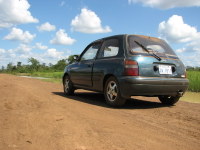
    The next morning at 6 am we were met by the driver and Kimsan, who had agreed to come along for the ride.  I was dismayed when I saw the car, a tiny Nissan with tire clearance of about 6 inches.  Not exactly the kind of car I imagined taking on a rough road across a remote part of Cambodia.

    The bumpy ride began almost immediately on leaving the town of Siem Reap.  Soon we were driving on a dirt track that was rutted and potholed so badly that our little car had to gingerly pick its way around them or risk getting swallowed whole.   

    On the bright side though, the journey took us by some remote temples that see few tourists because the road to get to them is in terrible shape. We stopped at Koh Ker, a large temple complex from the Angkor era, and had lunch from a vendor who had setup shop just outside. 

    After over 7 hours of nightmarish roads we reached our destination, Tbeng Meanchey.  A dusty town of 20,000 people with two restaurants.  Later, our kind guide Kimsan went to our hotel room and told us that the underside of the little Nissan had been damaged and needed repairs before making the journey home.  He gave us a hug and went off to join his friend to get the repairs made.
    Jungle_roadThe next day we were planning on going to visit Prasat Prea Vihear, a large temple a couple of hours north of the city.  However, Penny wasn’t feeling well and we had seen plenty of temples already so instead I spent the day trying to find someone to take us the rest of the way to Stung Treng. 

    Soon, the entire town must have known that two tourists wanted to get to Stung Treng.  We went
    out for dinner and on the walk got stopped by a couple of motorcycle drivers.  One of them spoke English and I was able to negotiate a fair price with him.  They seemed a bit young but claimed to know the way and that their motorbikes were in good condition. 

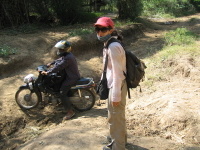
    The next morning at 6 am we set off.  The drivers put our large packs between their legs and we sat behind with our small packs on our back.  The “road” is actually a trail through the jungle.  At times when the main trail was blocked with a fallen tree or other obstruction the path around narrowed to be only a foot or two wide.Breakdown_number_1

    We soon reached our first stream.  There being no bridge, the motorbikes just drove across.  It dawned on me that wearing my hiking boots had been a bad idea when the motorbike I was on stalled halfway through the shallow stream and I had to walk across. 

    We waited for a long time until the two drivers were able to get the stalled bike restarted.  It was
    now about 7 am and we still had at least 5 more  hours of travel to reach Stung Treng.  I started to think that the whole adventure may have been a very bad idea.
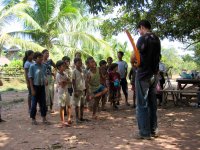
    Making_balloons_in_chaeb_villageHowever, after a few more stalls we finally reached the isolated village of Chaeb, which is at about the halfway point.  There our drivers decided that they would rather return home than continue the trip to Stung Treng.  They showed us to two other people who were going to Stung Treng and said that we would ride with them the rest of the way.  Seeing they had newer motorbikes helped me to agree to the unexpected change.

    While we waited for our new drivers to eat lunch I made some balloon animals for a group of village kids that seemed to gather from nowhere.  My balloons ran out and it was time to leave again.  This time the motorbikes ran well and the trail improved a bit, things seemed to be going well.

    Unfortunately, within 20 minutes of leaving the village we were on the side of the path with a flatPenny_dusty_and_not_amused tire.  Our new drivers didn’t have a pump with them so we sat down and waited. Luckily, a few minutes later three army guys on motorbikes came from the opposite direction and we borrowed their pump.  With the tire re-inflated we made only another 10 minutes before the tire was flat again.  This time the good motorbike made the trip back to Chaeb to buy a patch and glue to repair the tire.  We sat by the side of the trail and waited again.  Over an hour later the tire was repaired and we were on our way again.
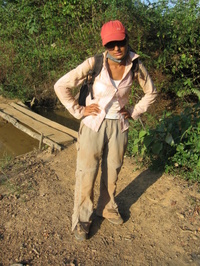
    After another 4 or 5 hours of the bumpiest and dustiest travel imaginable, and with a very sore backsides, we reached the Mekong River.  A short ferry ride across and we were in Stung Treng.

    When we finally checked into the hotel at 6 pm the clerk looked at Penny and I, literally covered  from head to foot in red dust, and asked where we had come from.  “Tbeng Meanchey”, we told her.  Her face looked surprised, “How did you get here from there?”

  • Joseph

    There are photos of our visit to the Angkor temples and Siem Reap in the Cambodia album.

    The main reason tourists come to Cambodia is to visit the temples of Angkor.  The Khmer empire peaked in the 12th century and left behind huge temple complexes with dozens of temples scattered around the jungles of northern Cambodia. 

    The rapidly growing town of Siem Reap is the base for visiting the the Angkorian temples.  We Angkor_sunrise arrived here by bus from Phnom Penh about 6 hours away over one of the few paved highways in the country.  Once here we were swarmed by tuk tuk drivers at the bus station offering to be our drivers for the duration of our stay.  A tuk tuk is a motorcycle which pulls a covered carriage.  It is the most popular way to travel between sites here.  We found a driver named Kimsan who we immediately liked because he was shy and reserved as opposed to the usually loud drivers. 

    Kimsan drove us around to see the temples for the next two days.  The temples were built during a time of heavy Indian influence and were initially constructed in worship of Hindu deities.  As the influence of Buddhism grew, the temples started to be devoted to Buddha and it is interesting to see the way that the two have grown together.  It is common to see a temple here with carvings of Vishnu on the exterior and a statue of a seated Buddha in the central chamber.

    View_from_top_of_angkor_to_outer_walls Our first day started with an early visit to Angkor Wat, the largest and most famous temple in Asia.  It is actually said to be the largest religious monument of any kind in the world.  We arrived before the sunrise and walked along the causeway across a moat in total darkness.  Then we found a place on the inner wall of the complex and sat back to watch an incredible show.  The sky slowly lightened and the silhouette of the majestic temple appeared in front of us.

    For the next two days we visited temples, each different in their own way.  Some are restored, some are still covered in jungle, one has such detailed stone carvings that it is said that it could only have been built by women and one is widely known as the "Tomb Raider" temple because it appeared in the Angelina Jolie film.  I’ll spare you the details and instead post pictures in a new album.  Enjoy!

  • Penny

    There are 2 options for overland travel from southern Vietnam to Cambodia.  You can take the bus or you can choose the more scenic boat option.  Joe and I decided that for the same amount of Family_by_shore time, the boat was the way to go.  In Chau Doc, Vietnam, we organized our entry into Cambodia.  We decided to go with the slower and much cheaper option of the slow boat versus the speed boat.  The trip would take 8 hours and would require that we change boats at the border and take a one and a half hour bus ride from the Cambodian landing port to the city.

    Although difficult and strenuous, the trip proved to be unforgettable.  Along the shores of the Mekong, there were lots of little farming villages.  Many families had built homes by the river banks and as we traveled north, we were able to see how daily life unfolds in this part of the world. 

    Kids_by_shore The warmth, smiles and "hellos" of the children were the most memorable part of the journey.  As we sailed past in our beaten up boat, the children bathing, playing or working by the river bank would stop and start screaming at the top of their lungs "Hello!" and would wave furiously at us with huge smiles.  The constant waving was too much for me but Joe waved like royalty throughout the ride… His technique rivals that of the Queen’s.

    The slow boat trip is not for everyone.  It is really hot in Cambodia and in a covered no-aircon questionable boat, it can get pretty miserable.  But if you are up for it, the children make all the difference!  Here are some details:

    Where to book:  Most hotels in Chau Doc sell trips by boat and bus to Cambodia

    Cost: USD $8 (or USD $17 for the fast boat)

    Time: About 8 hours in total including the border crossing

    Most tour operators take care of obtaining a visa for you.  The cost of the visa is USD $20 at the border and our operator charged an extra USD $2 for the service of getting it.  The service was well worth the cost.

  • Joseph

    We’ve uploaded a new album with photos from Southern Vietnam, including Phu Quoc.  It’s on the left hand side of the page.

    The tear shaped island off the south end of Vietnam is home to about 50,000 people, mostly fishermen and their families.  Of more interest to us though were the beautiful beaches that ring most of the island.  Long_beach_at_sunset

    The main town on the island is sleepy Duong Dong.  Just south of it is a long stretch of fine golden sand beach with about a dozen guesthouses or small hotels that rent bungalows; this is where most visitors stay.  The island has so far managed to avoid attracting any mega resorts or large hotels  so travelers who come here typically rent a small bungalow on the beach.  Not wanting to buck that particular trend we did exactly the same thing and settled in for a few days of relaxation. 

    Long Beach is the strip of sand where the hotels are located and many people are happy to spend their entire time on Phu Quoc there.  The sand stretches away in both directions as far as the eye can see, palm trees provide shade and small fishing boats work just off the shore.  During the dry season (now) the water is very calm and warm, perfect for swimming.

    There are only a couple of restaurant/bars on the beach but most of the hotels and guest houses have their own in-house places.  They make a fine place to have a glass of freshly squeezed mango juice or Saigon Beer and watch the spectacular sunsets.  Our bungalow was right next to one of the larger operations, the Tropicana Hotel, and we had dinner there every night.

    On our second day there I rented a small motorcycle from the hotel.  Never having driven a motorbike I was given a 10 minute lesson in how to operate it by the bemused rental guy.  We drove around a couple of times on the cobble and sand road leading to the guesthouse and I was ready to go.  Phu Quoc is a good place to learn how to ride a motorcycle; there is little other traffic and no reason to go anywhere fast.

    Fishing_village With Penny riding behind me we set out to visit the southern half of the island.  We took the road across the island and after about 8 km we reached the other side at a small fishing village.  As is usually the case in Vietnam we were soon surrounded by small children all saying, “hello, hello, hello…”  We pulled away and walked down a long pier so we could see the houses along the shore.  Most were built on stilts with bamboo, thatch, and usually a blue tarp or two.

    Although they are lucky to have easy access to the sea the population of the island is quite poor and their houses reflect that.  The soil is very bad for growing crops; everywhere that we saw gardens or  fields they were covered in a white layer of salt.

    We left the fishing village and continued south along the coast to what was billed as the most beautiful beach on the island.  We found the one restaurant close to the beach and ordered a lunch of fresh shrimp and noodles.  After eating we took a walk along the water.  Bai Sao Beach indeed does have silky white sand and beautiful palm trees.  However, there are no hotels on the beach and no one picks up the litter that is left there or the trash that washes ashore.  The result is a beautiful beach that is  ruined by the large amount of rubbish on it.  Unfortunately, littering is very commonplace in Vietnam and most people seem to think nothing of it.  We were disappointed with the beach so we left early and continued to drive around the island.  Fishing_boat_on_land

    The main artery along the coast is a red dirt road which took us by the houses of fishermen and along the southern end of Long Beach.  As the sun was setting the views kept me looking to the left.  I should have been looking straight ahead as we almost ran into a herd of cattle being led down the road! 

    Our time in Phu Quoc felt like a mini vacation before some harder traveling we’re coming up on in Cambodia and Laos.  But our time was up and we left for the Cambodian border and what promises to be more rugged travel and adventure.

    Details –
    Hotel: We stayed at Hiep Thanh but there are about a dozen places that rent bungalows on the island. 
    Cost:  Bungalow prices range from USD $10/night to USD $25/night depending on whether you want AC and how close you are to the beach.  Motorcycle rental is USD $7/day.
    How to get there: There are two main ways to get to Phu Quoc.  We took the ferry from Rach Gia on the mainland to get there – about USD $10 and 2.5 hours.  We took a flight back to Rach Gia on the return journey –  about USD $20 and 25 minutes.