Joseph
To a casual observer it appears that the Kei islanders are religiously devout people. In the main town of Langgur there are several large churches and mosques; including a massive new church under construction that would be among the largest buildings on the island. There are churches and mosques in even the smallest fishing villages.
Kei islanders traditionally worshiped their ancestors and believed in a very active spirit world that influenced their day to day lives. Succeeding waves of Muslim, Catholic and Protestant missionaries have converted virtually all of the islanders to one of their three religions. However, the people of Kei have not entirely let go of their spirit beliefs and this has led to a curious mix of customs. Apparently the priests and mullahs, most of whom are from Kei islands, tolerate the dual beliefs of their flock.
There is a giant old tree next to the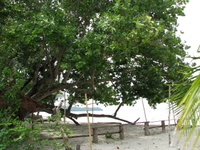 Savanna Cottages that the islanders believe has some mystical powers. In times gone by the chiefs of warring villages would stand beneath the tree and reach a peace agreement. An agreement made under the tree could not be broken. It was used again as recently as 2000 when local Protestants and Muslims agreed to stop fighting and signed the agreement under the tree.
Our host Gerson was raised in Holland and was naturally skeptical about the spirit beliefs of the islanders; that is until a group of six medium from Jakarta stayed at his cottages. Without knowing the legends about the tree the mediums asked him, “Can’t you see them?” Gerson looked about and not seeing anyone answered, “Who?” The mediums pointed to the tree and said, “The people standing beneath the tree.” The mediums went on to tell him not to worry because the spirits under the tree were “good people”. Now, Gerson believes in the spirits like do most Kei islanders.
Gerson doesn’t lock the doors to his home. He believes that the presence of the tree on one side and a cemetery on the other protect him from theft; and so far he has been right. Theft is not a big problem on the island but he adds, “The local people would be too scared to try to steal anything with the spirits of their forefathers watching.”
Although Kei is modernizing quickly traditional beliefs are still strong in the majority of people on the island, and this can lead to some funny situations. A couple of years ago a few palm leaves were used to completely stop traffic on the only bridge connecting the two main Kei islands. Someone had erected a magical sasi; a construct of young palm leaves that islanders believe cannot be crossed without terrible consequences. No one crossed the bridge for several months!
To make a sasi, village elders conduct a ceremony invoking spirits and make offerings of gold to them. They have traditionally been used to protect crops, property and to mark disputed borders with neighboring villages. In the case of the bridge sasi the islanders suspected it was a boat owner who put up the sasi to cash in on the huge increase in demand to shuttle people the short distance between the islands. The bridge remained unused until the government paid to have a special sasi removal ceremony performed.
The Kei Islanders also have odd traditions when it comes to getting married. Throughout Southeast Asia we have spoken to numerous young men who have complained about not being able to afford to g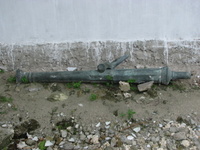 et married. The "bride-price" is the amount of money, buffalo, cows, goats or whatever that must be paid to the family of the girl he wants to marry. The high bride price and additional cost of the wedding causes great frustration to the men (and I suppose the women too) who want to get married and can’t afford the expense.
But the Kei Island men have an even weightier problem. Part of the bride-price they must pay to their bride’s family is a real Dutch cannon. Yes, a cannon. A mini-cannon used by Dutch colonists is the usual form of payment. It cannot be a replica cannon, it must be an original. How this tradition came about is not clear. The kepala desa, or village chief, of where we stayed had a cannon outside his home that he had received from his son in law. This cannon was a regular sized cannon, I guess being a kepala desa has its advantages.


 One Year Away