• Penny

    We have posted 4 new pictures in the India album, enjoy!

    Another train ride, this time from Agra, took us to Delhi, a city where you should expect to see everything and anything.  We stayed in the backpackers’ ghetto of Paharganj.  The area is very dirty and filled with touts.  It is not a great first impression of Delhi but it is central and convenient.  Thankfully, the rest of Delhi is much more pleasant.Relaxing_at_connaught_place

    We spent a total of five days in Delhi.  Two days were spent recovering from Delhi-belly while the remaining three were spent site seeing and trying to enjoy some of the great Indian food that we had missed out on the two first days.

    We spent some time relaxing at Connaught Place near the fountain in Central Park with hundreds of other locals as we enjoyed the relative coolness of the evening. 

    In Old Delhi, we visited the Old Fort and Jama Masjid, the largest mosque in India.  While there we also had the chance to enjoy some of the best butter chicken masala we have ever had at Moti Mahal Restaurant.  The next day we had the best jalebis (a circular, deep fried, squiggly sweet filled with sugar syrup) from Jalebis and Samosas where they specialize in what else but jalebis and samosas.  This small street side shop is constantly preparing the Indian treats fresh for customers.  For some reason, we were only allowed to buy one jalebi.  The vendor said that we could buy more after we had tasted them and liked them.  After only having one between the two of us, Joe and I were stuffed.  Although our taste buds wanted more, it was much safer to simply step away from the jalebis.

    Intersection_in_old_delhi No trip to Delhi is complete without some shopping in the city’s many markets and bazaars.  If you are able to dodge the touts offering to take you to a store to buy silk saris and are able to bargain hard, Delhi has some great shopping for housewares and fabric.  We decided to splurge on some Indian spices from Roopak’s.  The store was filled with sealed containers of spices from tea masala to the spicy kashmiri curry.  But be prepared for an attack on your nostrils when you enter.  The smell was so powerful it was physically painful.

    Delhi is a very large city with many different neighborhoods and you can easily spend a week visiting the many sites.  If you plan on visiting, make sure that you do it in the cooler months – i.e. not in April, May or June!

  • Penny

    Take a look at the India album. We have added 4 new Taj Mahal photos!  Enjoy.

    The second city that we visited in India was Agra.  We took a 15 hour overnight train ride on a non-air conditioned train to get there (we have pre-booked all of our future rides to make sure that we get air conditioning). Taj_mahal_classic_photo_2 

    As most tourists, we went to Agra simply to see the Taj Mahal.  The Taj is a Mughal mausoleum that was built by Emperor Shah Jahan to honor his wife who died while giving birth to their fourteenth child in 1631.  The Taj is a monument of love that took 22 years to build.  The structure is composed of beautiful white marble and inlaid with semi-precious stones representing flowers and Koran scriptures. 

    We wanted to be there for sunrise, so we got up at 5 AM and were at the ticket office at 5:30 AM as the sun started to come up.  unfortunately, the ticket office only opened at 6 AM.  Thankfully, we were in the Taj by 6:30 AM and were able to take advantage of the soft dawn light for some pictures. 

  • We’ve added new photos from our time in India so far.  Not surprisingly it’s in the India album on the left.

  • Joseph

    Inside_of_auto_rickshawHindus believe that if you die in the city of Varanasi you are freed from the cycle of rebirth and enter Nirvana.  We came to Varanasi for two reasons; to see the Ganges river at the holiest city along its shore, and far more practically, because it’s close to Kathmandu and there were inexpensive flights.

    Our first glimpse of India came from the back of an auto rickshaw as we puttered along to the old town from the airport.  Our driver had his head turned completely around to speak to us while happily ignoring the honking trucks, rickshaws, wandering cows and their resulting piles of dung, bicycles, pedestrians, potholes and old Ambassador cabs.  Only by the grace of Vishnu did we arrived at the old town in one piece. 

    The main reason to visit Varanasi is to see the ghats; wide stone steps that lead dow n to the river.  They are used as a place from which to bathe in the holy water of the river, wash clothes and just hang out.  On a narrow landing above the steps impromptu cricket matches are played by the young boys of the town. 

    We woke up early one morning to take a ride in a row boat along the ghats as the sun was rising.  Even atEarly_morning_bathing_in_the_gang_2 that early hour the ghats were crowded with people washing themselves in the river.  The men lathered themselves up and then jumped into the river.  The women wore their colourful saris even while bathing. 

    Unfortunately, 30 sewers dump raw sewage into the river at Varanasi and tests show that it has 3000 times the safe amount of fecal matter in it.  One rickshaw driver we hired insisted that since the river flowed from the feet of Vishnu the water was pure and good.   I remained unconvinced and there would be no bathing in that water for me. 

    The most memorable sight along the river though was the cremation of bodies.  Out of respect for the families we did not take any photos.  Devout Hindus want to be cremated along the holy river and then have their ashes spread into the water.  We met the owner of a cremation service by one of the “burning ghats” and he took us through the process as we stood and watched 3 different cremations all going on at the same time. 

    Since there is no way to preserve the bodies in the heat the families usually arrive with the body within 5-7 Spiritual_cleansing_at_the_gangeshours of the death.  The family informs the ghat workers what kind and amount of wood they want for the pyre.  The logs are meticulously weighed and the family is charged per kilogram of wood.  Rich families opt for sandalwood because it is more prestigious and smells nice when burned.  When the pyre is built, the body, covered in cloth, is laid on top and the male family members walk around 5 times then light it with a holy flame brought from a nearby temple.  The ghat workers tend the fire and  make sure that the body burns completely.  At one point they use a bamboo pole to break the charred remains and stir them into the coals. 

    The whole process happens out in the open.  Within 5 meters of a body being prepared for cremation some local kids were playing cricket with the ball zooming past the family members.  In the river next to the ghat water buffalo cooled themselves, dogs lazed in the sun and onlookers watched the cremations. 

    Women family members are not allowed to attend the cremation of their loved-ones.  One reason we were told is that women tend to cry during the cremation and their cries do not allow the soul of the deceased to leave the body and to reach nirvana. Another is that wives of the deceased used to throw themselves on the fire as their husband burned.  This practice of was outlawed 7 years ago…

  • Joseph

    The top news story in India at the moment is headlining all the TV channels.  People are protesting  across the country.  The media is having a field day.  Effigies of Richard Gere are being burned in the street.  Effigies of Richard Gere are being burned in the street???  Yes, believe it or not.  Actor Richard Gere has caused a huge controversy here by playfully kissing Bollywood actress Shilpa Shetty at an AIDS awareness rally in Mumbai.  In several cities across the country, including here in Varanasi, cardboard pinata-like busts of the actor were burned as people protested his conduct.  They complain that his kiss shows he has no regard for this country’s culture and should be kicked out.  Wow…

    See here for photos…Pics of Gere and Shilpa. Oh, and we’re in India and doing well.  The heat though is almost unbearable and is only going to get worse.  We’ll post about the colourful and ancient city of Varanasi shortly…but we thought you should get the important Bollywood news first.

  • Joseph

    6.30 AM – Wake up.  Peek out of sleeping bag…it’s cold in the room.  Get out and quickly change out of night clothes into walking clothes.

    7.00 AM – Meet Clare and Darroch (our trekking companions) and Kaji and Laddu (our guide and Entering_tal_village porter).  Order a breakfast of milk tea, boiled eggs and Tibetan bread (a delicious fried bread).  Over breakfast we look at our maps and trekking books to see what’s in store for us that day.  After breakfast we fill two water bottles and treat them with iodine tablets.

    8.00 AM – Pay lodge bill and  hit the trail.  Kaji walks in the lead with the rest of us following mostly in single file on the often narrow trail.

    8.02 AM – Leave village area and follow the trail into the hills.

    9.00 AM – Walking, walking, walking…

    10.00 AM – Tea stop.  We find a small tea house on the trail and stop for a break and to have a drink.  A big pot of milk tea and a small one of hot lemon are much appreciated.Homely_lodge_sign
     
    11.00 AM -Walking, photo stop, walking…

    12.00 PM – Getting hungry…but our destination for the day is only one hour walk away.  We find a chultara (stone bench/resting area) and eat a chocolate bar.  We keep walking.

    1.00 PM – Around the next bend we see the collection of stone houses that is our destination.  The largest buildings and those with corrugated metal roofs are the tourist lodges.  We walk into the village and Kaji leads us to a lodge he knows.  We greet the owner, inspect the rooms and drop our bags.

    1.15 PM – Lunch time!  We try to order similar meals to each other so that the lodge owner has an easier time and uses less firewood for cooking.  Dal bhat is the favorite dish – it is a tin tray with four sections with rice, lentils, curried vegetables and a pickle.  Free refills…

    2.30 PM – One by one we make our way to the solar heated shower to take advantage of the water while it’s still hot.Typical_lodge

    3.30 PM – After a brief look around the village it’s time for a rest.  A nap or long break to read.

    6.00 PM – Meet for dinner in the lodge dining room.  Instead of Dal bhat this time we order some fried noodles with vegetables, egg and yak cheese.  Yummy!

    7.00 PM – Darroch teaches us how to play a new card game.  When the power cuts off we continue playing by candlelight.

    8.30 PM – Bedtime!  We’re tired from the walk and want to sleep.  The altitude makes sleep difficult though and we wake up several times in the night.  On the plus side, dreams are vivid and easily remembered. 

  • PennyPenny_with_yaksfinally

    Before leaving Canada, a couple of my co-workers (you know who you are) made me promise to get a picture of me and a yak.  So, here you go guys!  Enjoy…

  • We’ve added a Nepal album with tons of photos of our trek.  Some of the photos (including many of the best ones) were taken by Darroch or Clare, our trekking companions.  To save on memory card space we tried to use only one camera at a time.  Enjoy the pics!

  • Penny

    For a map of the Annapurna Circuit please go to http://www.annapurnatrek.com/annapurna_map.html
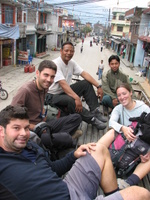
    Starting_journey_on_the_roof_of_a_2The primary reason
    for coming to Nepal was to do one of the multi-day
    mountain treks that the
    country is famous for. Once here, we decided that the way to go was
    the Annapurna Circuit. We and our newly
    found English friends, Clare and Darroch, decided to hire both a porter and
    guide for the 21 day trek. We went to
    meet Kaji and Laddu from the Overseas Adventure Travel company and after a
    short talk decided to take them on. For
    the next 21 days, Clare, Darroch, Laddu, Kaji and us walked over 300 km around
    the Annapurna Mountain range and reached heights of 5,416 meters above sea
    level.
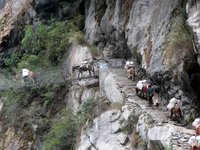
    Mule_train_crossing_suspension_brid
    The circuit takes you
    through the Marsyangdi river valley, over the Thorong-La pass and through the
    Kali Gandaki valley which was once an ancient Tibetan trade route. There are no vehicle roads in this
    mountainous area. The only way to get
    around is by walking trail. We shared
    the trail with porters, mules, horses and locals who traveled between the
    mountain villages. Most of the products
    available in the villages on the trail, including the chocolate bars and Tang
    drink mix, have to be brought in by porters, mules or helicopter. As a result, a chocolate bar at the highest
    points on the trail can go for over 100 Rupees (about CAD $1.70).

    The difficult access
    to many of the villages has ensured that they have remind untouched by most
    modern development. Houses are made of
    local stone and timber. Villagers are involved
    in agriculture, raising livestock (primarily goats, cows, oxen, yak and nak)
    and running tourist lodges. Most houses
    do not have running water and most cooking is done by wood fire. Electricity is sometimes available but you
    often have to have a candle or torch available to cope with the numerous power
    cuts that are both scheduled and non-scheduled.

    The quietness of this
    area will not last for long. There are
    big projects underway to build a road that would provide vehicle access up to
    Manang on the western part of the trail and up to Muktinath on the east. While this is unfortunate for trekkers, this
    road may be the difference between life and death for locals requiring medical
    assistance who would previously have had to walk up to several days to the
    nearest doctor.
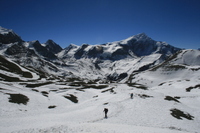
    Approaching_thorongla_passThe trail is
    challenging, but anyone of average fitness should be able to do it. The two major concerns
    are weather and
    altitude. Thorong-La pass is one of the
    highest mountain passes in the world at 5416 meters. At this time of the year snow storms can make the pass too dangerous to cross. In fact, days before we set off on our trek,
    snow at the pass had forced many trekkers to abandon the circuit. Also, above heights of 3,000 meters some
    people start to feel the effects of altitude sickness such as nausea, vomiting
    and shortness of breath even when resting… The key is to ascend slowly and to make sure that you get acclimatized –
    that means spending a minimum of 2 nights at an altitude of about 3,500 meters
    before going any higher. It’s also
    important to not gain over 300 meters of altitude in one day. Thanks to a good trekking plan/route and to
    our experienced guide and porter, we were all healthy and strong throughout the
    trek.

    For those interested
    in completing the Annapurna Circuit, here is the itinerary we followed:

    Day 1: Local bus from Kathmandu to Bhulbhule
    Day 2: Trek to and stay in Ghermu (near Syange)
    Day 3: Trek to and stay in Tal
    Day 4: Trek to and stay in Temang
    Day 5: Trek to and stay in Chame
    Day 6: Trek to and stay in Lower Pisang
    Day 7: Take the harder but more rewarding Upper
    route and trek to and stay in Ghyaru
    Day 8: Trek to and stay in Braga for 2 nights
    Day 9: Stay in Braga and climb up to get a
    blessing from the 100 Rupee Lama (great for acclimatization)
    Day 10: Trek to and stay in Yak Kharka
    Day 11: Trek to and stay in Thorung Phedi
    Day 12: Trek to and stay in Ranipawa – this is the
    day you go over the Pass!
    Day 13: Trek to and stay in Kagbeni
    Day 14: Trek to and stay in Marpha
    Day 15: Trek to and stay in Kalopani
    Day 16: Trek to and stay in Dana
    Day 17: Trek to and stay in Tatopani
    Day 18: Trek to and stay in Shika
    Day 19: Trek to and stay in Ghorepani
    Day 20: Trek to and stay in Tirkedhunga – if the
    weather is good that morning go up to Poon Hill for sunrise

    Day 21: Trek to Nayapul and take a bus/taxi to
    Pokhara

    Also, if you are in
    ne
    ed of a guide or porter, we highly recommend Kaji and Laddu. They took care of us and we had a great tKaji_and_laddu_guide_and_porterime together. If you wish to get in contact
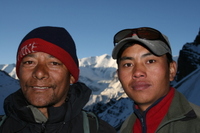
    with them you can email Kaji (via his daughter) at
    ami
    ta_shrestha65@hotmail.com or contact
    us and we can also give you telephone numbers where they can be reached.

    The trek offers great
    views of the Annapurna range mountains. On the trail, you can see two of the fourteen over 8,000 meters
    peaks: Annapurna 1 and Dhaulagiri. The first couple of days of the trek,
    whenever we would see a large peak that was often snow covered, we would ask
    Kaji: “Kaji, what is that mountain
    called?” He replied with a chuckle: “That is not a mountain. That is
    a hill!” When we got our first look at
    real mountains we finally understood.

  • Rural_chinese_villagers

    These villagers were arranging rice stalks to dry in the sun.  They are used as animal feed in the winter.